High Angle Motion Base Platforms
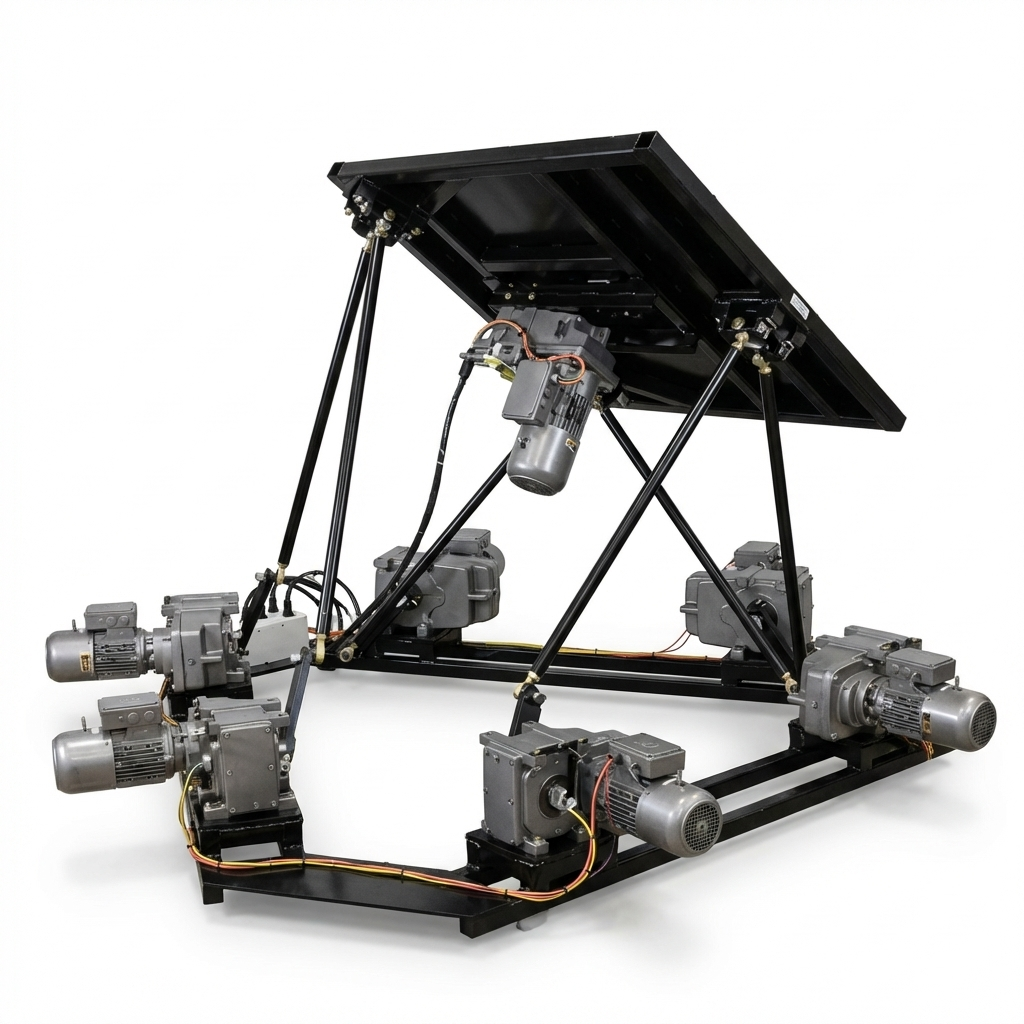
The High Angle Motion Base Platform by Servos & Simulation, Inc. is engineered to meet the rigorous demands of simulation and testing environments.
Designed for precision, this platform replicates real-world movements with exceptional accuracy, making it an essential tool for both research institutions and commercial enterprises.
Applications - Industries
Six-axis motion base platforms are highly versatile and used in a variety of sectors, including:
- Military training simulations
- Commercial entertainment systems
- Medical and research testing environments
For example, in the entertainment industry, these platforms power immersive virtual reality experiences that rely on precise motion feedback. In military settings, they simulate real-world scenarios to enhance training effectiveness. Thanks to their adaptability, these platforms are a valuable asset in any professional simulation environment.
Customization Options
At Servos & Simulation, we understand that no two projects are alike. That’s why we offer extensive customization options, including:
- Payload capacities
- Platform dimensions
- Control system configurations
- Motion profiles
Whether you require a specific stroke length, angular range, or integration with existing systems, our engineering team will work closely with you to deliver a solution that fits seamlessly into your operational framework.
Key Benefits
Investing in a six-axis motion base platform provides several advantages:
- Enhanced training realism
- Servo-Driven motion architecture
- Greater user engagement
- Improved operational flexibility
- Durability and long-term reliability
Moreover, our platforms feature advanced motion control technology for smoother, more responsive movement—critical for high-stakes environments such as flight simulation and medical testing.
Servos & Simulation platforms are engineered to support FAA FTD, CPT, and FFS certification requirements when integrated into qualified simulator architectures.
Weight Capacities
We offer a range of standard payload capacities to suit different applications:
- 500 lbs (227 kg) – Ideal for gaming rides, VR setups, and small equipment testing
- 1,000 lbs (454 kg) – Suitable for rides with 1–4 passengers
- 2,000 lbs (907 kg) and up – Designed for multi-seat configurations with walkways
- 4,500 lbs (2,041 kg) and 8,000 lbs (3,629 kg) – Built for large-scale entertainment rides
Custom stroke and payload combinations are also available upon request. High payload motion platform designs are customizable.
Technical Specifications
We have High Angle Systems for our total line of motion platform systems.
Please be aware that a majority of motion platforms cannot go past 40 degrees from horizontal or the motion base will collapse.
In order to add more anglularity, we have to install another motion base on top of the first. In this senerio, the system gains angularity, but looses payload.
All systems are servo-controlled with a closed feedback loop between the motor and controller, ensuring precise, real-time response to input signals—whether from a computer or analog control voltage. Notably, our systems operate without the need for encoders, limits, or stops typically required in linear systems.
Optional Control Systems
All motion base platform systems from Servos & Simulation are plug-and-play ready, offering flexible control options to suit a wide range of applications and user preferences.
With several six-axis (6DOF) models available—starting at 500 lbs. (227 kg) and scaling upward—each system is designed to operate using a simple ±7.5VDC analog control input, making integration straightforward and versatile.
Included Components
Every motion base platform system includes:
- Integrated electronics in a COTS rack-mount chassis
- Up to 50 feet of interface cabling
- Hubbell 220VAC plug, mating input connector, and generic system manual
- Integrated safety braking system and e-stop integration
- Full system manual (ICD and maintenance) with complete drawing set
- One-year warranty and lifetime email/phone technical support
Computer Control
If the customer chooses to purchase the computer system for motion base control, the package includes:
- Custom Interface Control board
- Input cable
- Operating system
- Keyboard and mouse
- Maintenance software for the motion base
Additionally, for entertainment ride profile playback, the computer can broadcast video while simultaneously controlling the motion base. Customers may specify video card output requirements at contract time (additional cost applies). Systems rated at 8,000 lbs or larger include the computer as a standard component.
Sensoray 826 Card
The Sensoray 826 is our standard interface card, included with the computer control option. It supports:
- ADC and DAC functions
- Digital I/O
- Watchdog capabilities
This card ensures reliable and precise control across all supported motion base platforms.
The customer is more than welcome to choose their interface. Be aware that if you require excellent movement of the system, 16-bit resolution on the DAC output is required. We are here to help with engineering and advice where and when you need it.
Raspberry Pi & Phidgets
Because the system accepts analog signals, it can also be controlled using:
- A Raspberry Pi with a 16-bit DAC installed
- A Phidget card, such as the 1002_0B or OUT1002_0
This option is ideal for home-built flight simulators and supports integration with platforms like Prepar3D, Flight Simulator Steam, and X-Plane. Note: This option is not recommended for larger systems due to limited fidelity.
Measurement Computing Devices
All Measurement Computing ±10VDC analog output devices are compatible with our motion base systems. For optimal performance, we recommend consulting our engineering team to identify the fastest available device to avoid any limitations in motion responsiveness.